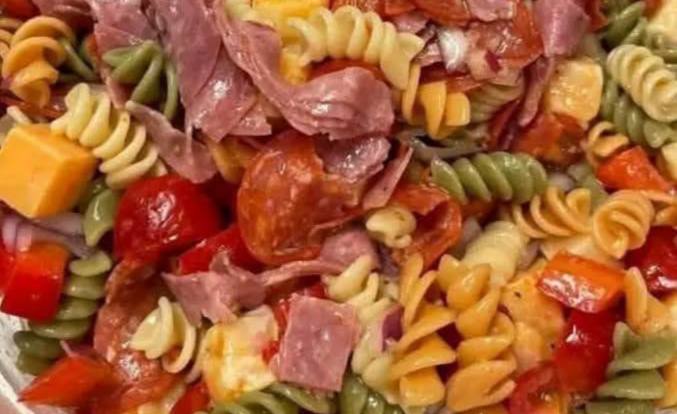
If you have ever filled a paper plate at a backyard graduation party, neighborhood block party, or family fourth of July bash, you have run into this vibrant dish. The classic Zesty Italian Pasta Salad is the undisputed champion of the warm-weather buffet line. Visually striking with its trio of green, orange, and white rotini spirals, it is a savory, tangy powerhouse packed with cured meats, sharp cheeses, and crisp summer vegetables.
Yet, despite its ubiquitous presence, it’s remarkably easy to make a subpar pasta salad. We’ve all encountered versions that are either swimming in a puddle of oily separation or, conversely, completely dried out because the cold pasta drank up every drop of moisture overnight, leaving the noodles chalky and bland.
Creating a benchmark pasta salad requires more than just opening jars and dumping them into a bowl. The trick lies in managing the porosity of the pasta, seasoning at the right temperature, and engineering a dressing that binds to the spirals rather than slipping off to the bottom of the bowl. Master these simple steps, and you’ll create a side dish that anchors the entire menu.
The Art of the Overnight Marination
There is a distinct culinary reason why this dish carries the golden rule of always being made the night before. Pasta salad eaten an hour after assembly tastes completely different from pasta salad that has spent twelve hours resting in the refrigerator. Over the course of the night, a process of osmosis occurs: the starchy, porous rotini spirals slowly absorb the herbaceous, vinegar-forward notes of the Italian dressing, flavoring the noodles from the inside out. Simultaneously, the salt and acids in the dressing draw out just enough moisture from the fresh vegetables to soften their raw crunch without losing their snap.
Through managing high-volume events and endless summer caterings, I learned that the fatal flaw of most pasta salads is the cooling method. Many home cooks plunge their cooked pasta into an ice bath or rinse it under cold tap water to stop the cooking. This washes away the valuable surface starches that help the dressing cling to the noodle.
Instead, the key is to drain the hot pasta and toss it immediately with just a third of your dressing while it is still warm. As the starch cools, it pulls that vibrant flavor deep into the crumb of the pasta, ensuring every bite is intensely savory rather than just coated in oil.
Recipe Overview
- Prep Time: 20 minutes
- Cook Time: 10 minutes
- Rest Time (Overnight): 8 hours (minimum)
- Yield: 12–16 side servings
- Difficulty: Easy
Ingredients You’ll Need
For the Salad Base
- Tri-Color Rotini Pasta: 1 lb (16 oz)
- Genoa Salami: 4 oz, cut into bite-sized ribbons or quarters
- Pepperoni (Sandwich style or mini): 4 oz, sliced or quartered
- Cheddar Cheese or Provolone: 6 oz, cut into small $\frac{1}{4}$-inch cubes
- Fresh Mozzarella Pearls: 4 oz, drained
- Cherry Tomatoes: 1 pint, halved lengthwise
- Red Bell Pepper: 1 medium, finely diced
- Red Onion: $\frac{1}{2}$ medium, finely minced
- Black Olives: 1 can (2.25 oz), drained and sliced
For the Emulsified Zesty Dressing
- Zesty Italian Dressing Mix: 1 packet (or 1 cup of high-quality store-bought zesty Italian dressing)
- Extra Virgin Olive Oil: $\frac{2}{3}$ cup
- Red Wine Vinegar: $\frac{1}{3}$ cup
- Fresh Lemon Juice: 1 tablespoon (for brightness)
- Grated Parmesan Cheese: $\frac{1}{4}$ cup
- Dried Oregano & Garlic Powder: $\frac{1}{2}$ teaspoon each
- Freshly Cracked Black Pepper: To taste
Step-by-Step Instructions
Step 1: Cook the Pasta Right
Bring a massive pot of heavily salted water to a rolling boil. Add the tri-color rotini. Cook the pasta according to the package directions, but aim for the exact threshold of al dente—usually about 8 to 9 minutes.
Why this matters: Do not overcook the pasta. Cold salads soften the pasta further as it sits in the acidic dressing overnight. If you start with soft, over-boiled noodles, they will break apart into an unappetizing mush when you toss the salad later.
Step 2: The Warm Infusion
Drain the pasta thoroughly in a colander, shaking out all excess water. Do not rinse it with cold water. While the pasta is still steaming hot, transfer it to your largest mixing bowl. Pour roughly $\frac{1}{3}$ cup of your prepared Italian dressing directly over the hot noodles and toss gently. Let the pasta cool completely to room temperature on the counter, stirring occasionally to prevent sticking.
Step 3: Prep the Add-Ins
While the pasta cools, prep your colorful components. Ensure your meats are cut into uniform, bite-sized pieces so they distribute evenly. Blot your halved cherry tomatoes and drained olives with a paper towel to remove surface wetness that could dilute the dressing.
Step 4: Assemble the Mosaic
Once the pasta is completely cool to the touch, add the cubed cheddar, mozzarella pearls, salami, pepperoni, tomatoes, red bell pepper, minced red onion, and sliced black olives directly to the bowl.
Step 5: Emulsify and Pour
In a mason jar or medium bowl, vigorously whisk together the remaining Italian dressing, olive oil, red wine vinegar, lemon juice, grated parmesan cheese, oregano, garlic powder, and black pepper. Whisking incorporates the parmesan and oil into a temporary emulsion, which prevents the dressing from instantly separating when poured. Pour all but $\frac{1}{2}$ cup of this dressing over the salad components.
Step 6: The Overnight Rest
Use a large rubber spatula to fold the ingredients together from the bottom up, ensuring every nook of the rotini spirals is coated. Cover the bowl tightly with plastic wrap or a secure lid and place it into the refrigerator for at least 8 hours, though overnight is highly preferred.
Step 7: The Event-Day Refresh
About 30 minutes before serving, remove the pasta salad from the refrigerator. You will notice the noodles have absorbed much of the liquid. Pour the reserved $\frac{1}{2}$ cup of dressing over the salad and toss gently to revive the glossy finish and wake up the flavors. Give it a final taste, adjusting with a splash of red wine vinegar or a pinch of salt if needed. Serve chilled.
Common Mistakes & How to Avoid Them
- Rinsing Away the Starch: Rinsing the pasta under cold water removes the thin coating of starch that naturally develops on the outside of the noodle during boiling. Without this starch layer, the dressing cannot grip the pasta effectively and simply slides straight to the bottom of the serving bowl.
- Cutting Components Too Large: If your cheese cubes or meat slices are larger than the rotini spirals, they will separate into distinct layers at the bottom of the bowl. Keep your cuts uniform and small so that every single forkful contains a perfect bit of everything.
- Serving Directly from the Refrigerator: Olive oil solidifies slightly when chilled. Serving the salad freezing cold masks the flavors of the meats and spices. Letting it sit on the counter for 15–20 minutes before serving allows the fats to loosen up and unleash their full flavor profile.
Ingredient Substitutions & Variations
- The Supreme Vegetarian: Omit the pepperoni and salami completely. Replace them with drained artichoke hearts, blanched broccoli florets, and diced cucumbers for a refreshing, garden-centric alternate.
- The Tortellini Upgrade: Swap the tri-color rotini for cheese-stuffed tortellini to make the side dish remarkably decadent and filling.
- Greek Twist: Swap out the Italian dressing, cheddar, and pepperoni for a Greek vinaigrette, crumbled feta cheese, kalamata olives, and fresh dill.
Pro Tips for the Ultimate Batch
- Acid Adjustment: If your pasta salad tastes flat right before serving, don’t just dump in more salt. A tablespoon of fresh lemon juice or red wine vinegar will instantly cut through the heavy oil and wake up the savory flavors of the cured meats.
- The Cheese Contrast: Using two distinct cheeses—like a sharp, firm cheddar cube paired with a soft, creamy mozzarella pearl—creates an incredible variation in textures that keeps the salad interesting to eat.
Frequently Asked Questions
Can I make this several days in advance?
While an overnight rest is mandatory for maximum flavor, making it more than two days ahead can cause the vegetables, particularly the tomatoes and peppers, to soften too much and lose their structural crunch. Stick to a 12-to-24-hour window for the best results.
Why does my pasta salad seem dry the next day?
Pasta behaves like a sponge. As it sits, it continuously drinks up liquid. This is completely normal and why saving a portion of the dressing to toss in right before serving is a vital step in the process.
Can I use gluten-free pasta?
Yes, but exercise caution. Many gluten-free pastas (especially those based purely on corn or rice) release a large amount of starch and can become fragile or brittle when cold. Look for a high-quality chickpea or lentil-based pasta, and reduce the boil time slightly so it maintains its structure.