🌿 Kalanchoe Leaves: What You Should Know Before Trying a “Cancer Cure”
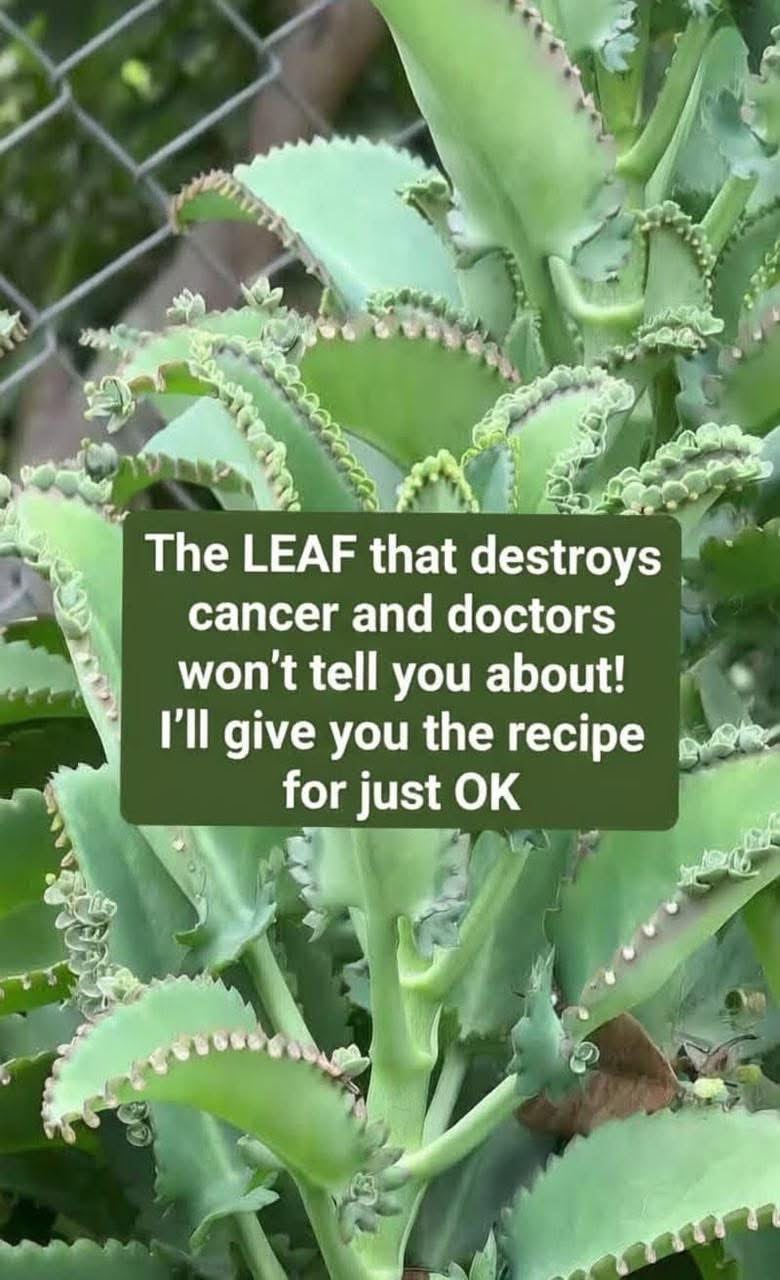
The plant shown in the image appears to be a Kalanchoe/Bryophyllum-type plant, recognizable by the tiny plantlets growing along the edges of its leaves. The image claims that its leaves “destroy cancer” and suggests that a recipe can be provided.
That claim should not be presented as a cancer treatment. There is currently no reliable evidence that eating Kalanchoe leaves, drinking a Kalanchoe preparation, or making a homemade extract can cure or destroy cancer. Most importantly, some Kalanchoe species contain bufadienolide compounds that can be toxic, so I would not recommend preparing a homemade drink, tea, juice, or concentrated extract from this plant.
Instead, here is a safe, informative version you can use for a health or recipe-style post.
🌱 What Plant Is This?
The plant appears to belong to the Kalanchoe/Bryophyllum group, often called mother of thousands, mother of millions, or air plant, depending on the species.
One of its most distinctive characteristics is its ability to produce tiny plantlets along the edges of its leaves. These miniature plants can eventually fall onto the soil and develop roots.
Because several Kalanchoe species look similar, it is difficult to identify the exact species from a photograph alone. That matters because different species can have different chemical compositions and safety considerations.
🧪 Why Do People Talk About Kalanchoe and Cancer?
Kalanchoe plants contain various biologically active compounds. Some laboratory studies have investigated compounds from Kalanchoe species for potential biological effects, including effects on cancer cells in laboratory settings.
However, there is a huge difference between:
“A compound affects cells in a laboratory experiment”
and
“Eating the plant cures cancer in humans.”
The second conclusion cannot be made from laboratory research alone.
A substance that appears promising in a test tube may be ineffective when consumed, may not reach the relevant tissues at an effective concentration, or may produce harmful effects before reaching a therapeutic dose.
Therefore, a homemade Kalanchoe preparation should not replace cancer treatment recommended by an oncologist.
⚠️ Why I Wouldn’t Give a Kalanchoe “Cancer Tea” Recipe
Unlike an ordinary culinary herb, Kalanchoe isn’t something I’d recommend turning into a homemade medicinal beverage.
Some Kalanchoe plants contain bufadienolides, compounds that can affect the heart. In sufficient amounts, these compounds can be toxic.
The concentration can also vary depending on:
- The exact species
- The part of the plant
- How much is consumed
- The plant’s growing conditions
- How the preparation is made
- Whether the material is fresh or concentrated
That makes a social-media recipe such as “take several leaves, blend them with water and drink” particularly problematic.
A homemade preparation has no standardized dose, and concentrating the plant could potentially increase exposure to compounds that may be harmful.
So please don’t use the recipe suggested by the image as a cancer remedy.
🥗 A Safer Way to Support Your Health
If you’re interested in natural approaches to supporting health during or after cancer treatment, the safest approach is not to search for one “miracle leaf.”
Instead, focus on an overall nutritious eating pattern.
A simple vegetable-rich meal can include:
Ingredients
- 1 cup cooked lentils
- 1 tomato
- ½ cucumber
- 1 small carrot
- A handful of leafy greens
- ¼ red onion
- 1 tablespoon olive oil
- 1 tablespoon lemon juice
- Fresh parsley
- A small amount of salt and black pepper
Preparation
Cook the lentils until tender and allow them to cool slightly.
Chop the tomato, cucumber, carrot, onion, and parsley.
Combine the vegetables and lentils in a large bowl.
Add olive oil and lemon juice, then season lightly.
Mix everything together and serve.
This isn’t a cancer cure either, but it is a practical example of how plant foods, legumes, vegetables, and healthy fats can be incorporated into a balanced diet.
🌿 What About Natural Products During Cancer Treatment?
“Natural” does not automatically mean “safe.”
This is especially important for someone receiving chemotherapy, radiation therapy, immunotherapy, targeted therapy, surgery, or other cancer treatment.
Certain herbs and supplements can potentially:
- Interact with medications
- Affect blood clotting
- Affect blood pressure or heart rhythm
- Change how medicines are metabolized
- Increase side effects
- Interfere with treatment
For this reason, anyone undergoing cancer treatment should tell their healthcare team about all herbs, supplements, teas, extracts, and concentrated plant products they are taking.
Do not stop prescribed cancer treatment because an online post claims that a plant can cure cancer.
🔬 What Does “Anti-Cancer” Actually Mean?
This is another common problem with viral health posts.
A study might report that an extract has cytotoxic activity against cancer cells in vitro.
That sounds impressive, but it doesn’t mean the same extract cures cancer in a human being.
Before a potential cancer treatment can become established, researchers generally need evidence from progressively stronger forms of research, including properly designed human clinical trials.
They need to know things such as:
- Does it actually work in people?
- What dose is effective?
- What type of cancer does it work against?
- What are the side effects?
- How does it interact with existing treatments?
- Is it better than existing treatments?
- Is it safe for people with other medical conditions?
A social-media photograph cannot answer those questions.
🚫 Don’t Put Kalanchoe in the Eyes, Ears, or on Wounds
Another common mistake with “natural remedy” posts is assuming that a plant that grows naturally can safely be applied anywhere on the body.
That isn’t necessarily true.
I would not recommend putting Kalanchoe juice into the eyes or ears, drinking concentrated preparations, or applying homemade extracts to open wounds.
The fact that a plant is traditionally used in some cultures does not automatically establish that a particular preparation is safe, sterile, correctly identified, or effective.
🪴 If You Have This Plant at Home
You can simply enjoy it as an ornamental plant.
Kalanchoe is particularly interesting because of the tiny plantlets that develop along the leaf margins.
Simple propagation
Choose a healthy leaf or plantlet.
If using a naturally detached plantlet, place it gently on well-draining potting soil.
Keep the soil lightly moist but avoid keeping it constantly wet.
Give the plant bright light appropriate for its species and growing conditions.
Once roots develop, the young plant can establish itself in the soil.
This is a much safer way to enjoy the fascinating plant shown in the photograph than turning it into a homemade medicinal preparation.
❤️ If Someone Has Cancer
Cancer treatment should be individualized.
The appropriate treatment depends on the type of cancer, its stage, genetic characteristics, the person’s overall health, and many other factors.
Depending on the situation, treatment can involve surgery, radiation therapy, chemotherapy, immunotherapy, targeted therapy, hormone therapy, or combinations of these approaches.
Nutrition can still be important during cancer treatment, particularly for maintaining adequate calories, protein, hydration, and overall nutritional status. A registered dietitian or the patient’s oncology team can provide advice tailored to the individual’s treatment.
A plant-based remedy should never be used as a reason to postpone or discontinue proven treatment.
🌱 A Better Caption for This Image
If you’re posting this on Facebook, Pinterest, or another social platform, instead of repeating the claim in the image, you could use:
🌿
Have You Seen This Plant Before?
This fascinating Kalanchoe/Bryophyllum-type plant produces tiny plantlets along the edges of its leaves, earning it names such as “mother of thousands.”
You may see posts online claiming that Kalanchoe leaves can cure or destroy cancer. These claims should not be treated as established medical facts.
Although researchers have investigated compounds from Kalanchoe plants in laboratory research, that does not prove that eating the leaves or drinking homemade preparations can cure cancer.
Some Kalanchoe species also contain compounds that can be toxic, so homemade medicinal preparations should not be used without professional guidance.
🌿 Nature is fascinating—but natural doesn’t always mean safe.
❤️ If you have cancer or are receiving treatment, speak with your healthcare team before using herbs or concentrated plant preparations.
⚠️ Bottom Line
The image’s statement that this leaf “destroys cancer” is misleading, and I would not provide a recipe for consuming the plant as a cancer treatment.
There is also an important safety issue: some Kalanchoe species contain potentially toxic compounds, so experimenting with homemade teas, juices, extracts, or concentrated doses is not something I recommend.
If your goal is to create a long Facebook recipe/health post from this image, the safest approach is to present the plant as an interesting ornamental and traditional plant, clearly separate laboratory research from proven human treatments, and avoid instructions for consuming it as medicine.