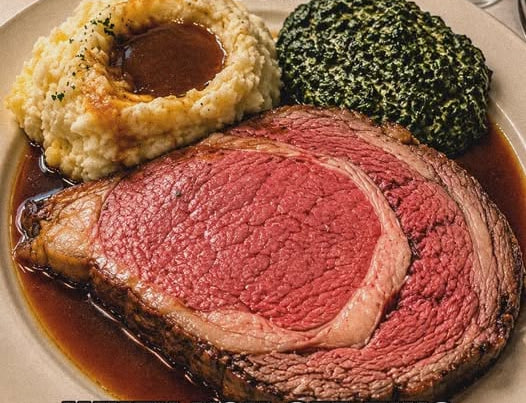
Prime rib has a reputation for being the roast people are most afraid to mess up — expensive, slow to cook, and easy to either undercook in the middle or turn gray at the edges. A thermometer solves almost the entire problem. Salt the roast well ahead of time, cook it low and slow until it’s just shy of done, then blast it with high heat at the very end for a deep brown crust. Pull it at the right internal temperature, and every slice comes out the same pink from edge to edge, no guesswork. The oven does most of the waiting; you just need patience and a thermometer you trust.
Why This Foolproof Prime Rib Roast Works
- A thermometer removes the guesswork. Cooking to an exact internal temperature, not a fixed time, is what makes this genuinely foolproof.
- Reverse searing means no gray ring. Cooking low first and searing at the very end keeps the meat pink from edge to edge, instead of a gray band under an overcooked crust.
- Dry-brining builds real flavor. Salting a day or two ahead seasons all the way through, not just the surface.
- The au jus uses what’s already in the pan. No extra stock pot to babysit — it comes together from the drippings while the roast rests.
What You’ll Need
You’ll want a roasting pan (a rack helps but isn’t essential), a reliable instant-read or leave-in meat thermometer — the one tool that actually makes this foolproof — and a small saucepan for the au jus.
For the roast:
- 1 bone-in prime rib roast (4 to 6 pounds, about 2 to 3 ribs)
- 2 tablespoons kosher salt (about 1 teaspoon per pound of meat)
- 1 tablespoon black pepper
- 4 cloves garlic, minced
- 2 tablespoons chopped fresh rosemary
- 1 tablespoon chopped fresh thyme
- 3 tablespoons olive oil or softened butter
For the au jus:
- Pan drippings, from the roast
- 2 cups beef broth
- 1/2 cup dry red wine, optional
- 1 sprig fresh thyme or rosemary
- Salt and black pepper, to taste
- 1 tablespoon butter, optional
Step-by-Step Instructions
- Dry-brine ahead of time. Pat the roast completely dry, then season all over with the kosher salt. Place uncovered on a rack in the fridge for 24 to 48 hours — this single step makes the biggest difference in flavor.
- Bring to room temperature. About 2 to 3 hours before cooking, remove the roast from the fridge and let it sit out, so it cooks more evenly.
- Make the herb paste. Mix the garlic, rosemary, thyme, black pepper, and olive oil into a paste. Rub it all over the roast.
- Roast low and slow. Preheat the oven to 225°F. Place the roast bone-side down in a roasting pan and insert a thermometer into the thickest part, away from the bone. Roast until it reaches 115 to 120°F for medium-rare, about 3 to 4 hours for a 4- to 6-pound roast.
- Rest, then crank the heat. Remove the roast and tent loosely with foil. Increase the oven to 500°F (or as high as it goes) and let it fully preheat, about 20 minutes.
- Sear. Return the roast to the hot oven and cook 10 to 15 minutes, until deeply browned and the internal temperature reaches 125 to 130°F for medium-rare — your kitchen will smell like a steakhouse by the time the crust sets.
- Rest again. Let the roast rest 15 to 20 minutes before carving — this lets the juices settle back into the meat instead of running out onto the board.
- Make the au jus. While the roast rests, pour off excess fat from the roasting pan, leaving the browned bits. Set the pan over medium heat, add the broth and wine, and scrape up the browned bits as it simmers. Add the herb sprig and simmer 5 to 10 minutes to reduce slightly, then season and swirl in the butter.
- Carve and serve. Slice the roast against the grain and serve with the warm au jus.
Pro Tips
- Pull the roast by temperature, never by time. Oven quirks, bone size, and starting temperature all vary too much for a clock alone to be reliable.
- Use a leave-in thermometer if you have one. Constantly opening the oven door to check with an instant-read lets heat escape and slows everything down.
- Remember carryover cooking. The internal temperature climbs several degrees after the roast comes out of the oven, which is why you pull it before it hits your final target.
- Don’t skip tenting during the rest before searing. A loose foil tent keeps the surface from cooling too much before it goes back in for color.
- Save the bones. If the butcher separated them, tie them back on before roasting, or simmer them separately afterward for a rich stock.
Variations & Alternatives
- Boneless roast: Works the same way; without the bones acting as a natural rack, set the roast on a wire rack in the pan instead.
- Smaller roast: A 3-rib roast under 4 pounds will hit temperature closer to 2 1/2 hours in the low oven — start checking early.
- Horseradish cream: Stir prepared horseradish into sour cream with a pinch of salt for a classic, no-cook accompaniment.
- No red wine: Skip it and use all beef broth in the au jus; the flavor will be a touch less complex but still good.
Storage & Reheating
Refrigerate leftover roast and au jus separately in airtight containers for up to 4 days. Reheat slices gently in a low oven (275°F) with a little au jus spooned over to keep them from drying out — high heat or the microwave will push an already-cooked roast past medium-rare fast. Sliced leftovers also make excellent sandwiches served cold or barely warmed.
FAQ
How long does a prime rib roast take to cook? At 225°F, plan on roughly 30 to 40 minutes per pound to reach medium-rare, though a thermometer is a far more reliable guide than time alone.
What temperature should I pull prime rib for medium-rare? Pull it from the low oven around 115 to 120°F, then sear until it reaches 125 to 130°F — the final internal temperature after resting.
Do I really need to dry-brine the roast in advance? It’s not strictly required, but it makes a real difference in both seasoning and crust. Even a few hours ahead helps; 24 to 48 hours is ideal.
What’s the difference between prime rib and a ribeye roast? They’re the same cut of beef — prime rib is simply the traditional name for a bone-in ribeye roast cooked whole, rather than sliced into individual steaks.
Foolproof Prime Rib Roast with Au Jus — Recipe Card
Prep Time: 20 minutes Room Temp Time: 2 hours 30 minutes Cook Time: 3 hours 45 minutes Resting Time: 20 minutes Total Time: 6 hours 55 minutes (day-of; dry-brine 24 to 48 hours ahead is separate) Servings: 6 to 8 Course: Main Dish Cuisine: American
Ingredients
- 1 bone-in prime rib roast (4 to 6 lbs, 2 to 3 ribs)
- 2 tbsp kosher salt
- 1 tbsp black pepper
- 4 cloves garlic, minced
- 2 tbsp chopped fresh rosemary
- 1 tbsp chopped fresh thyme
- 3 tbsp olive oil or softened butter
- Pan drippings, from the roast
- 2 cups beef broth
- 1/2 cup dry red wine, optional
- 1 sprig fresh thyme or rosemary
- Salt and black pepper, to taste
- 1 tbsp butter, optional
Instructions
- Dry-brine with kosher salt, uncovered in the fridge, 24 to 48 hours ahead.
- Bring to room temperature, 2 to 3 hours, before cooking.
- Rub with a paste of garlic, herbs, pepper, and oil.
- Roast at 225°F until it reaches 115 to 120°F internal, 3 to 4 hours.
- Rest, tented, while the oven preheats to 500°F, about 20 minutes.
- Sear 10 to 15 minutes, until 125 to 130°F internal.
- Rest 15 to 20 minutes, then carve against the grain.
- Simmer pan drippings with broth, wine, and herbs for the au jus; season and serve.