📝 Ingredients
For the cake batter
- 4 large eggs, separated
- 100 g (½ cup) granulated sugar
- 1 teaspoon vanilla extract
- 100 g (about 7 tablespoons) unsalted butter, melted
- 120 g (1 cup) all-purpose flour
- 500 ml (2 cups) whole milk, lukewarm
- 1 tablespoon water
- 1 small pinch of salt
- 1 teaspoon lemon zest, optional
For the top
- 1 tablespoon powdered sugar, optional
- A little butter for greasing the baking dish
👩🍳 Instructions
1. Prepare the oven and dish
Preheat your oven to 160°C / 320°F.
Grease a rectangular glass baking dish generously with butter. A dish around 20 × 20 cm (8 × 8 inches) works well.
You can also line the bottom with parchment paper to make serving easier.
2. Separate the eggs
Separate the egg whites from the yolks carefully.
Place the yolks in a large mixing bowl and the whites in another completely clean bowl.
The egg whites are important because they will give the dessert its characteristic light and fluffy texture.
3. Beat the egg yolks
Add the sugar to the egg yolks and whisk for approximately 2–3 minutes, until the mixture becomes pale and creamy.
Add the vanilla extract and melted butter.
Make sure the butter has cooled slightly before adding it. You don’t want it to be hot enough to cook the eggs.
Whisk everything until smooth.
4. Add the flour
Sift the flour directly into the egg mixture.
Mix gently until the flour is completely incorporated.
Don’t worry if the batter looks thicker than expected at this point.
5. Add the milk
Gradually pour in the lukewarm milk while whisking continuously.
Add the tablespoon of water and, if using, the lemon zest.
The final mixture will be quite thin and liquid. That’s completely normal.
This thin batter is what allows the dessert to develop its soft custard-like interior during baking.
6. Whip the egg whites
Add a small pinch of salt to the egg whites.
Using an electric mixer, beat them until they form soft peaks.
Don’t overbeat them until they become extremely stiff and dry.
Soft, fluffy egg whites are ideal for this recipe.
7. Fold everything together
Add the whipped egg whites to the thin batter in three additions.
Use a spatula and fold gently.
You don’t need to completely eliminate every little lump of egg white. In fact, leaving some small fluffy pieces floating in the batter helps create the distinctive texture and layers.
The mixture will remain quite liquid with visible pieces of whipped egg white.
8. Pour into the dish
Pour the mixture carefully into your prepared glass baking dish.
Gently smooth the surface with a spatula.
Do not shake or stir the batter excessively.
Place the dish on the middle rack of your preheated oven.
9. Bake
Bake for approximately 50–65 minutes, depending on your oven and the size of your baking dish.
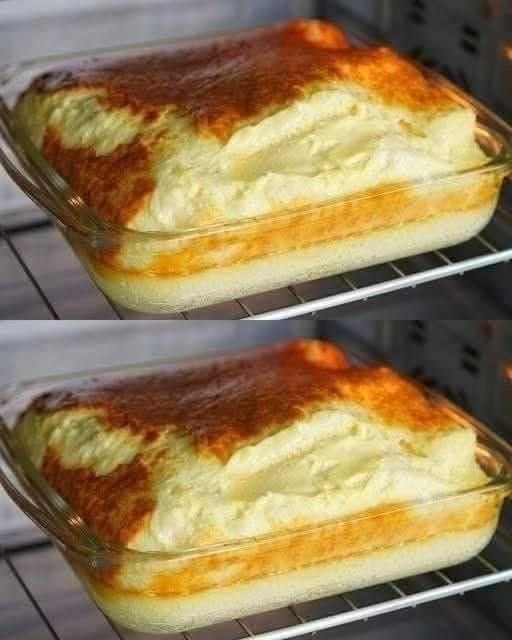
The top should become beautifully golden brown, just like the dessert in the photo.
The center should still have a very slight wobble when you gently move the dish.
Don’t worry if it rises considerably while baking. It may puff up beautifully in the oven and then settle slightly as it cools.
That’s normal.
10. Cool completely
Remove the cake from the oven and place the dish on a cooling rack.
Allow it to cool at room temperature for about 1 hour.
Then cover it and refrigerate for at least 2 hours.
For the best texture, I recommend chilling it overnight.
As it cools, the creamy center becomes firmer and the flavors become richer.
11. Serve
Cut the cake directly in the glass dish into squares or rectangles.
Dust lightly with powdered sugar if desired.
You can serve it cold straight from the refrigerator or allow it to sit at room temperature for about 10–15 minutes before serving.
✨ Tips for the Perfect Texture
Use whole milk.
Low-fat milk can work, but whole milk gives the dessert a much richer, creamier texture.
Don’t skip the egg separation.
The whipped egg whites are responsible for the light, airy texture.
Don’t overmix after adding the egg whites.
Gentle folding is essential.
Use lukewarm milk.
Very cold milk can make the melted butter solidify and make the batter less smooth.
Don’t overbake.
The center should remain slightly soft. If you bake it until completely firm, the finished dessert may lose its creamy texture.
Let it chill.
This dessert changes considerably as it cools. The layers become more defined and the custard center becomes wonderfully creamy.
🍓 Delicious Serving Ideas
Although this cake is delicious on its own, you can make it even more special with:
- Fresh strawberries
- Raspberries
- Blueberries
- Sliced peaches
- Whipped cream
- Vanilla ice cream
- Caramel sauce
- Chocolate sauce
- Powdered sugar
- Fresh lemon zest
- A drizzle of honey
For a particularly elegant presentation, place one square of the chilled cake on a plate, dust it with powdered sugar, add a few fresh berries and finish with a small spoonful of whipped cream.
🥛 Why Does It Form Layers?
The magic of this dessert is that you start with one thin batter, but after baking you can get several different textures.
The heavier ingredients settle toward the bottom while the whipped egg whites help create a lighter upper portion.
The result is a dessert with a soft base, a creamy custard-like middle, and a fluffy upper layer covered by a golden-brown crust.
That’s why desserts in this family are often called magic cakes.
The exact appearance can vary depending on your oven, baking dish, and how gently you fold the egg whites.
⏱️ Approximate Timing
- Preparation: 20 minutes
- Baking: 50–65 minutes
- Cooling: 1 hour
- Chilling: 2–4 hours
- Total: approximately 4–6 hours, mostly because of cooling and chilling
🍰 Storage
Keep the cake covered in the refrigerator.
It should stay delicious for approximately 3–4 days when properly refrigerated.
Because this is an egg-and-milk-based dessert, don’t leave it sitting at room temperature for extended periods.
For the best flavor and texture, serve it chilled.
❤️ Final Result
You should end up with a dessert that has a deep golden, lightly caramelized top, a delicate fluffy layer underneath, and a wonderfully soft, creamy interior.