Why White Vinegar Works in Laundry
White vinegar is essentially a mild acid (acetic acid), and this gives it several powerful cleaning properties:
- It breaks down detergent residue that builds up in fabrics
- It dissolves mineral deposits from hard water
- It neutralizes odors instead of masking them
- It helps restore the natural softness of fibers
Over time, towels and white clothes can become stiff, dull, or slightly gray—not because they’re dirty, but because of product buildup and hard water minerals. Vinegar tackles both of these problems at the source.
🧼 The Most Common Mistakes People Make
Before getting into the correct method, it’s important to understand what people usually do wrong:
❌ Adding vinegar with detergent
This is the biggest mistake. Vinegar is acidic, while most detergents are alkaline. When combined, they can partially cancel each other out, reducing cleaning power.
❌ Using too much vinegar
More is not better. Excess vinegar can:
- Leave a lingering smell
- Potentially weaken fabric fibers over time
- Affect rubber seals in washing machines if overused
❌ Pouring it directly on clothes
Undiluted vinegar can sometimes cause uneven exposure, especially on delicate fabrics.
✅ The Right Way to Use Vinegar for Laundry
🧴 Method 1: For Softer Towels
This is the most popular and effective use.
Step-by-step:
- Load your washing machine with towels as usual
- Add your regular detergent to the detergent compartment
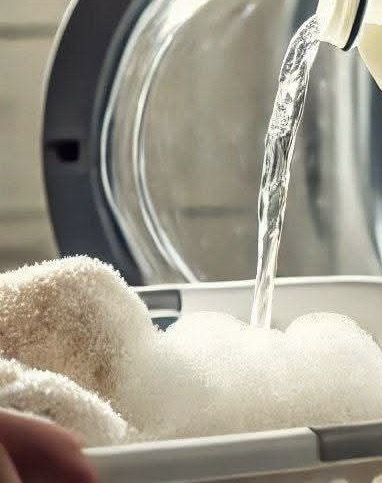
- Pour ½ to 1 cup of white vinegar into the fabric softener compartment
- Run a normal wash cycle with warm water
Why this works:
The vinegar is released during the rinse cycle, where it:
- Removes leftover detergent
- Breaks down stiffness
- Restores fluffiness
Result:
- Towels feel softer without chemical softeners
- Better absorbency (fabric softeners often reduce this)
👕 Method 2: For Brighter Whites
If your white clothes look dull or slightly yellow/gray, vinegar can help revive them.
Step-by-step:
- Fill the washer with warm water
- Add 1 cup of white vinegar directly into the drum
- Let clothes soak for about 30–60 minutes
- Then run a normal wash cycle with detergent
Optional boost:
Add a small amount of baking soda during the wash cycle (not at the same time as vinegar) for extra whitening power.
🌫️ Method 3: Removing Odors
Vinegar is excellent for eliminating stubborn smells like:
- Sweat
- Smoke
- Mildew
Step-by-step:
- Add clothes to the washer
- Use detergent as usual
- Add ½ to 1 cup vinegar during the rinse cycle
Result:
Instead of masking odors, vinegar neutralizes them completely.
🧽 Method 4: Deep Cleaning Towels (Stripping Method)
If your towels feel rough or smell even after washing, they may have heavy buildup.
Step-by-step:
- Wash towels with hot water + 1 cup vinegar (no detergent)
- Immediately run a second cycle with ½ cup baking soda (no detergent)
- Dry as usual
What happens:
- Vinegar removes residue
- Baking soda lifts remaining buildup and odors
🧪 The Science Behind It (Simple Explanation)
- Detergent residue = alkaline
- Vinegar = acidic
When used in the rinse cycle, vinegar:
- Neutralizes leftover alkalinity
- Breaks apart mineral deposits
- Leaves fibers clean and soft
That’s why timing matters so much.
⚠️ Important Safety & Care Tips
✔️ Safe to use on:
- Cotton
- Towels
- Most everyday fabrics
❌ Avoid using on:
- Silk
- Wool
- Delicate fabrics
⚠️ Machine care:
Using vinegar occasionally is fine, but avoid excessive use in:
- Older machines with rubber parts
- Seals that may degrade over time
Extra Tips for Best Results
🌀 Don’t overload your washer
Clothes need space to rinse properly for vinegar to work.
🌡️ Use warm water when possible
Helps dissolve buildup more effectively.
🌬️ Dry properly
Air drying or proper tumble drying keeps towels fluffy.
🍋 Add scent naturally
If you don’t like the vinegar smell (which usually disappears), you can:
- Add a few drops of essential oil to the softener compartment
- Use lavender, lemon, or eucalyptus
🤔 Does Vinegar Leave a Smell?
This is a common concern.
- During the wash: Yes, you may notice a mild smell
- After drying: The smell completely disappears
If it doesn’t, you likely used too much.
🧠 Final Thoughts
White vinegar is one of those rare household ingredients that is:
- Cheap
- Natural
- Highly effective
But the secret isn’t just using it—it’s using it at the right time and in the right amount.
When used correctly, it can:
- Transform rough towels into soft, fluffy ones
- Restore brightness to white clothes
- Eliminate stubborn odors naturally
So next time your towels feel stiff or your whites look dull, skip the expensive products and try this simple method—you’ll likely be surprised by how well it works.