Your culinary repertoire, which spans the fiery abundance of a Spicy Seafood Boil to the structured comfort of an Ultimate Breakfast Box, finds its most humble yet technically demanding entry in the Lancashire Butter Pie. While your Creamy Potato Salad celebrates the potato in a cold, tangy format, this pie represents the “hot heart” of Northern English tradition—a dish born of necessity that has become a symbol of regional pride.
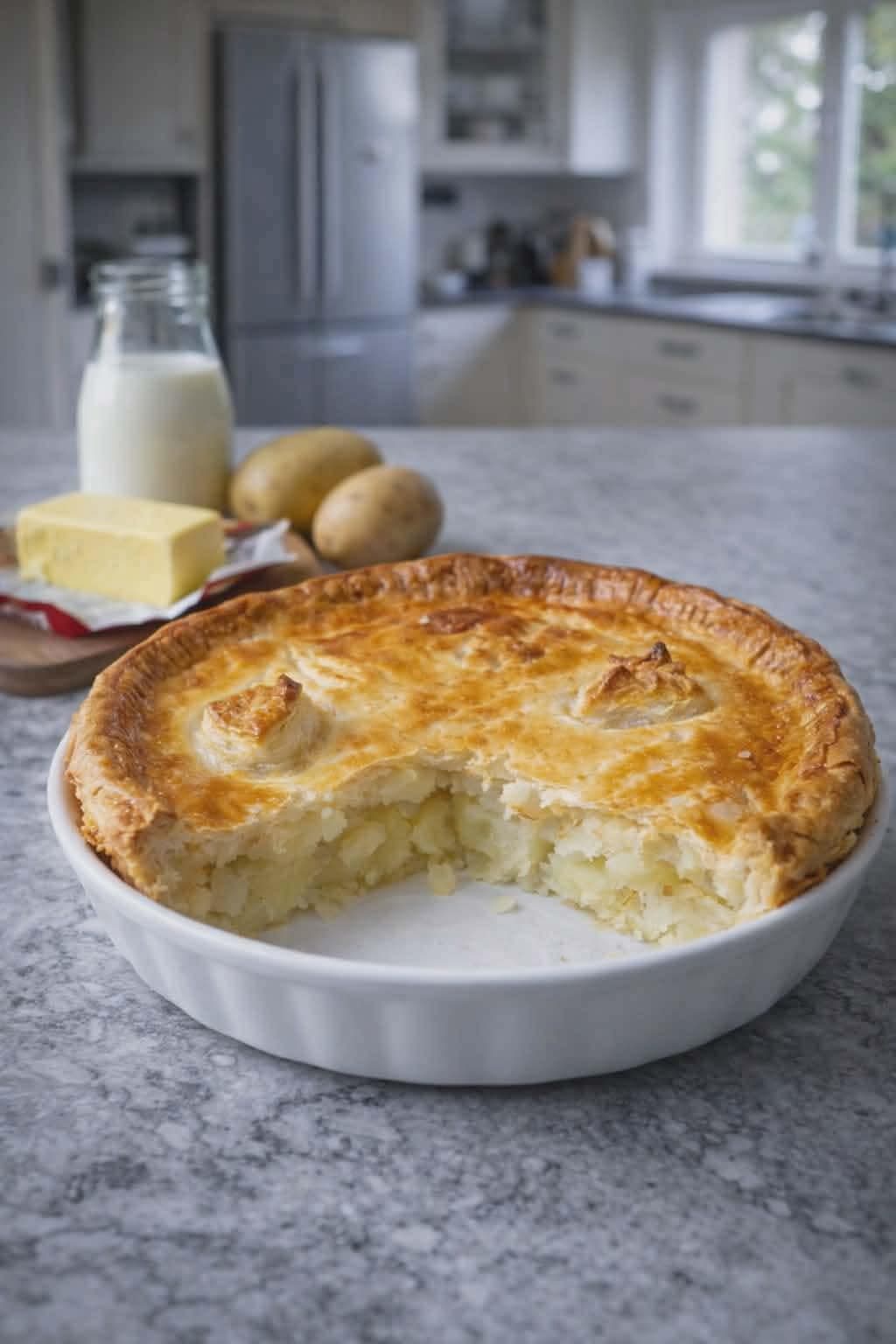
Your presentation features a deep-dish ceramic vessel holding a thick, golden-crusted pie with a slice removed to reveal a dense, steaming interior of layered potatoes.
1. Visual Anatomy: The Architecture of the Crust
The visual hallmark of a professional Butter Pie is the contrast between the rigid, structural pastry and the soft, yielding interior:
The “Lidded” Masterpiece
The pie features a full shortcrust lid that has been egg-washed to a high, glossy sheen. The edges show a classic “crimping” or “pinching” technique, which not only seals the steam inside to cook the potatoes but also provides a thicker, crunchier “handle” for the diner.
Pastry Decorative Elements
Two small, circular pastry vents or “leaves” are placed on the surface. These are functional as well as aesthetic; they allow internal pressure to escape, preventing the lid from cracking or becoming soggy from trapped moisture.
The Exposed Interior
The removed slice reveals a “stacked” potato structure. The potatoes are not mashed; they are thinly sliced or roughly cubed, holding their shape just enough to show the layers of the pie’s construction. The pale, creamy color of the interior confirms that no meat or heavy gravy was used, staying true to the pie’s “Lenten” or “Catholic” origins.
2. Technical Execution: The “Poor Man’s” Gourmet
The Lancashire Butter Pie—often called a “Friday Pie”—requires precision to ensure that a dish with so few ingredients (potatoes, onions, butter, and pastry) remains exciting:
- The Soft-Sauteed Onion: While the potatoes are the bulk, the flavor comes from onions slowly sweated in a generous amount of butter. They should be translucent and sweet, never browned, to maintain the pie’s light internal color.
- Potato Par-Boiling: The potatoes must be par-boiled in salted water before being encased in pastry. This ensures they are fully tender by the time the pastry is golden-brown, avoiding the “hard center” that ruins a starch-heavy dish.
- The Butter Ratio: The background of your photo features a large block of butter and whole potatoes, emphasizing the raw components. A true butter pie uses enough fat to create a “self-saucing” effect inside—where the butter and potato starch combine into a silky, rich binder.
3. Flavor Harmony: Simple, Salty, and Rich
This pie is a study in “monochrome” flavor, where the quality of the primary ingredient determines the success of the dish:
- Starchy Sweetness: The potatoes provide a mild, comforting sweetness that is enhanced by the slow-cooked onions.
- Butter Richness: The butter provides the “high notes,” offering a savory, fatty mouthfeel that coats the palate.
- Pepper Kick: Traditionally, these pies are heavily seasoned with white or black pepper to provide a subtle “back-heat” that keeps the dish from feeling too heavy.
4. Nutritional Insights: The Working Class Fuel
Designed to sustain workers during long shifts, the Butter Pie is a calorie-dense energy source.
| Ingredient | Benefit |
| Potatoes | High in Vitamin C, B6, and Potassium for heart and immune health. |
| Butter | Provides Vitamin A, D, and E, as well as essential fats for energy. |
| Onions | Rich in antioxidants and compounds that may help lower blood sugar. |
| Wheat Pastry | Offers complex carbohydrates for sustained energy release. |
5. Strategic Menu Pairings
To elevate the Lancashire Butter Pie from a simple snack to a full meal, consider these pairings from your collection:
- The Traditional Side: Serve with a side of steamed vegetables, like the Broccoli and Carrots from your roasted chicken dinner, to add color and fiber to the plate.
- The “Pickle” Contrast: The richness of the pie cries out for acidity. A side of pickled red cabbage or the tomato-onion salad from your Spicy Roasted Chicken provides the perfect sharp “cut”.
- The Comfort Duo: For a true Northern feast, serve a slice of this alongside a small bowl of your Beef and Potato Stew (though traditionally it was a meat-free meal, many modern diners enjoy the two together).
6. Frequently Asked Questions (FAQ)
Why is it called a Butter Pie?
It was traditionally made for Catholics in Lancashire who did not eat meat on Fridays. Since they couldn’t use suet or meat gravy, they used butter as the primary fat and flavoring agent for the potatoes.
Can I use leftover mashed potatoes?
While you can, it won’t be a traditional butter pie. The “slice” seen in your photo depends on the structure of the potato pieces; mash would create a “Potato Pie” or “Shepherd’s Pie” texture, which is much softer and less structural.
What is the best pastry for this pie?
A sturdy shortcrust is essential. Puff pastry is often too oily when combined with the internal butter, whereas shortcrust provides a crisp “biscuit-like” contrast to the soft filling.
7. Photography Analysis: The “Farmhouse Kitchen” Aesthetic
The photography of this pie uses a shallow “depth of field” to create a sense of home-cooked authenticity:
- Narrative Background: By including a bottle of milk, whole potatoes, and a block of butter in the blurred background, the photographer tells the story of the ingredients. It emphasizes that this is a “from-scratch” dish.
- Cross-Section Focus: The sharpest part of the image is the exposed potato filling, inviting the viewer to see the steam and the softness of the starch.
- Natural Lighting: The soft, side-lit illumination mimics a kitchen window, which reinforces the “comfort food” and “rustic” themes of the dish.