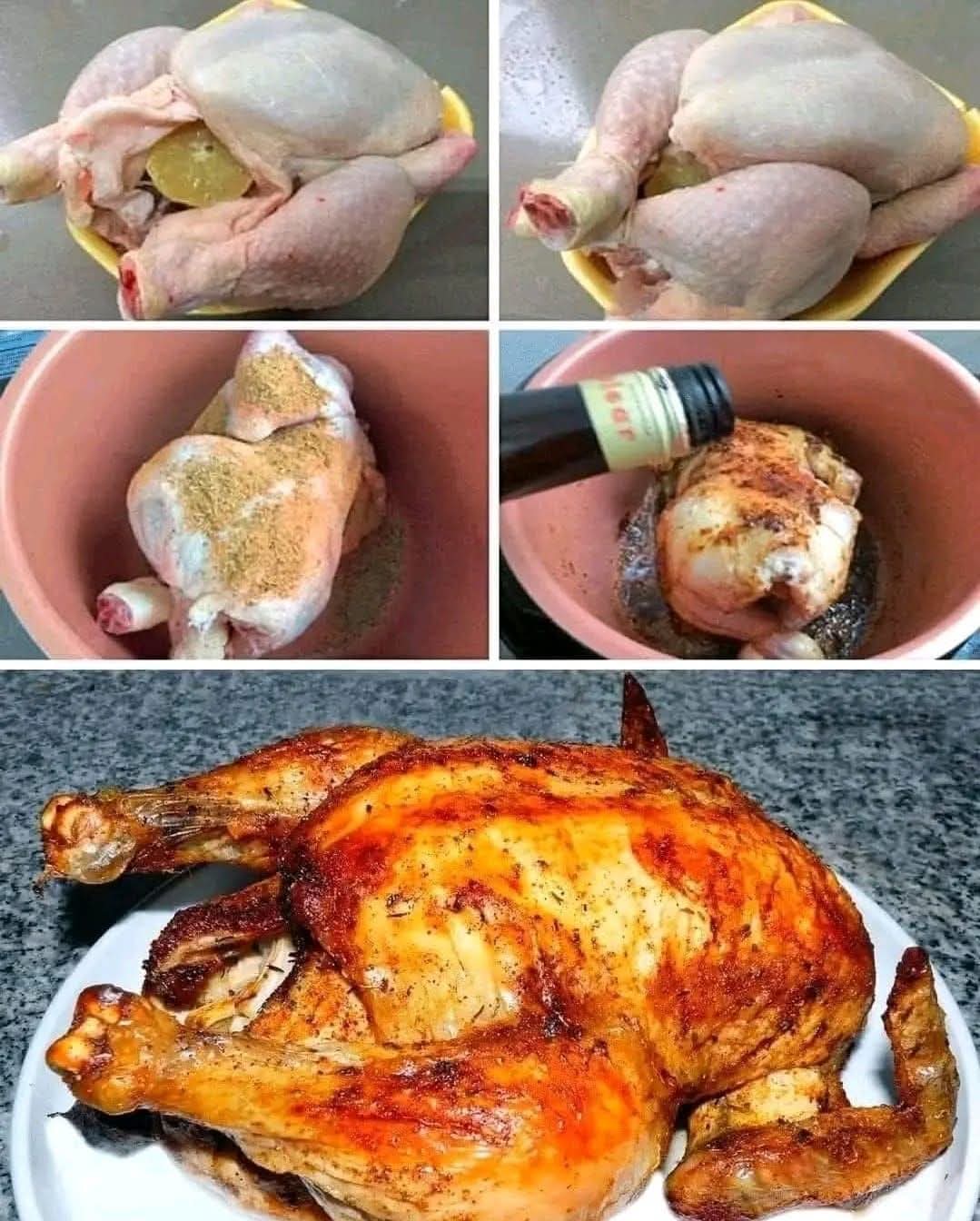
In your expansive culinary gallery—which journeys through the rustic depth of Pot Roast with Root Vegetables, the vibrant colors of a Roasted Beet and Burrata Salad, and the refined sweetness of Classic Caramel Flan—nothing quite captures the essence of home-cooked perfection like a Crispy Roasted Whole Chicken. While your Honey Garlic Wings master a sticky, high-gloss glaze and your Oven Roasted Chicken Thighs focus on localized skin crisping, roasting a whole bird is a technical marathon that requires uniform heat distribution and careful moisture management.
Your documented process showcases the transformation of a raw, lemon-stuffed bird into a mahogany-toned centerpiece with a skin so thin and brittle it appears to shatter at the touch of a knife.
1. Visual Anatomy: The Journey from Raw to Radiant
The success of this dish is evident in its staged progression, where each step contributes to the final structural and flavor profile:
Internal Aromatics and Prep
The process begins with a clean, raw bird where a thick slice of lemon is visible inside the cavity. This is a critical technical choice; as the chicken roasts, the lemon releases steam that infuses the breast meat with acidity and moisture, preventing it from drying out before the dark meat is fully cooked. The legs are tied or “tucked” to ensure the bird roasts as a compact unit, promoting even heat circulation.
The Seasoning Mantle
In the preparation phase, the chicken is coated in a dense layer of dry rub. The visible granules suggest a mix of salt, pepper, garlic powder, and perhaps paprika or dried herbs. This salt-heavy rub is essential for the “Crispy” title; salt draws moisture out of the skin, allowing the fat to render and the skin to dehydrate into a savory cracker-like layer.
The Deglazing and Basting
The documentation shows a dark liquid, likely a balsamic glaze, soy-based marinade, or wine-based sauce, being poured over the bird mid-roast. This introduces sugars that caramelize under high heat, creating the deep orange and dark brown “tiger-striping” seen on the finished skin.
2. Technical Execution: Managing the Maillard Reaction
A whole roasted chicken is a study in thermodynamics. To achieve the result seen in your final image, several technical milestones must be met:
- Surface Dehydration: Before the rub is applied, the bird must be patted completely dry. Any surface moisture will turn to steam in the oven, leading to rubbery skin rather than the brittle, “fried” texture achieved here.
- Fat Rendering: The high-heat environment of the roasting pan allows the subcutaneous fat to melt and baste the meat from the outside in. This is why the wings and drumsticks in your photo appear particularly dark and concentrated; they have a higher fat-to-meat ratio and crisp up more intensely than the breast.
- The “Carry-Over” Cook: The plumpness of the finished bird suggests it was removed from the heat at just the right moment, allowing the internal temperature to stabilize during a resting period. Resting is non-negotiable; it allows the juices to redistribute into the fibers of the meat, ensuring that when the crispy skin is breached, the meat remains succulent.
3. Flavor Harmony: Acidity, Earth, and Salt
The flavor profile of this roasted masterpiece is a multi-layered experience:
- Citrus Brightness: The lemon core provides a high-toned finish that cuts through the heavy, savory notes of the rendered chicken fat.
- Salty Umami: The exterior rub creates a concentrated “bark” that provides the primary savory punch of the dish.
- Caramelized Finish: The addition of the liquid glaze introduces a subtle sweetness that balances the salt and helps the skin achieve its iconic mahogany hue.
4. Nutritional Insights: The Lean Protein Centerpiece
A whole roasted chicken is one of the most nutrient-dense meals you can prepare, offering a variety of essential vitamins and minerals.
| Component | Key Nutrient | Benefit |
| Breast Meat | Lean Protein & Selenium | Supports muscle maintenance and thyroid function. |
| Thighs/Wings | Iron & Zinc | Crucial for energy production and immune system health. |
| Roasted Skin | Monounsaturated Fats | When consumed in moderation, provides satisfying flavor and healthy fats. |
| Lemon Infusion | Vitamin C (trace) | Adds a fresh aromatic quality that aids in the perception of flavor. |
5. Strategic Menu Pairings
To elevate this Roasted Chicken into a full Sunday feast, consider these pairings from your collection:
- The Starchy Anchor: Serve with the Roasted Potatoes found in your steak or meatball dishes. These potatoes are perfect for catching the drippings from the roasting chicken.
- The Fresh Contrast: Your Coleslaw or the Roasted Beet and Burrata Salad provides a cold, crunchy, or creamy counterpoint to the hot, salty chicken.
- The Bread Service: Use a slice of Rustic Rosemary Garlic Bread to mop up the lemon-infused juices at the bottom of the platter.
- Sweet Conclusion: Finish with the Peach Glazed Donuts or a slice of Banana Bread for a comforting, home-style ending.
6. Frequently Asked Questions (FAQ)
How do I prevent the breast meat from drying out?
As seen in your preparation, stuffing the bird with lemon is a great start. Additionally, roasting the bird breast-side down for the first 20 minutes can help the juices settle into the white meat before you flip it to crisp the skin.
What temperature is best for “Crispy” skin?
A high initial heat of 220°C for the first 15-20 minutes helps set the skin, followed by a reduction to 190°C to finish the cooking without burning the exterior.
Should I cover the chicken while roasting?
Never cover the chicken if you want the “Crispy” result seen in your photo. Covering traps steam, which will boil the skin rather than roast it, resulting in a pale, soft texture.
7. Photography Analysis: The Story of Transformation
The collage format used for this dish is a powerful storytelling tool:
- Process Transparency: By showing the raw bird and the seasoning phase, the photo builds anticipation for the final result.
- Color Saturation: The final, large frame emphasizes the rich, saturated oranges and reds of the skin, contrasted against the neutral granite background to make the “gold” of the bird pop.
- Proximity: The close-up on the roasted bird allows the viewer to see the texture of the skin, confirming the “crispy” promise made by the title.