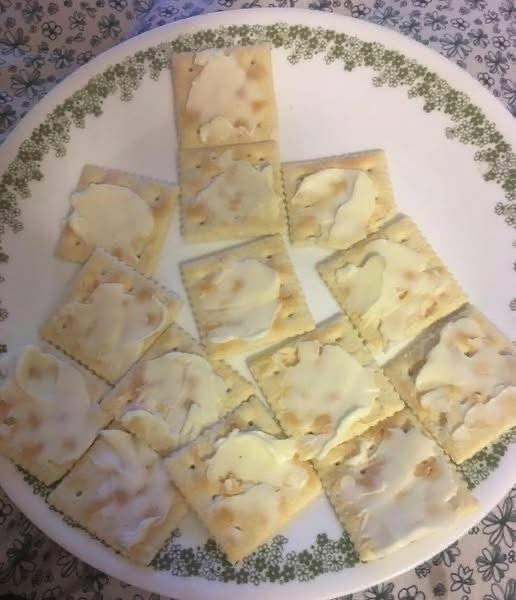
Ingredients (Simple Pantry Staples)
Saltine crackers are famous for how little they require. Each ingredient plays an important role.
🥣 Dry Ingredients
- 2 cups all-purpose flour
- 1 teaspoon fine salt
- 1 teaspoon sugar
💧 Wet Ingredients
- 2 tablespoons vegetable oil or melted butter
- 3/4 cup cold water (add gradually)
✨ For the Top
- Coarse salt (sea salt or kosher salt)
- Optional: melted butter for brushing
🧠 Understanding What Makes a Saltine a Saltine
True saltine crackers are:
- Very thin
- Low in fat
- Crisp, not crumbly
- Dry and crackly
The texture comes from:
- Low hydration dough
- Minimal fat
- Thin rolling
- Docking (tiny holes)
- Baking until fully dry
This recipe respects those principles while staying beginner-friendly.
🥣 Step 1: Mix the Dry Ingredients
In a large bowl, combine:
- Flour
- Fine salt
- Sugar
Whisk gently to distribute evenly.
👉 Why sugar?
It doesn’t make the crackers sweet—it helps with browning and flavor balance.
🥄 Step 2: Add Oil and Water Gradually
Add the oil to the dry ingredients and mix with a spoon or fingers.
Slowly pour in the cold water, a little at a time, mixing until a firm but smooth dough forms.
The dough should:
- Be stiff
- Not sticky
- Hold together when pressed
🚫 Do not add too much water—dry dough = crisp crackers.
✋ Step 3: Knead Briefly
Turn the dough onto a clean surface and knead for 3–4 minutes, just until smooth.
This develops enough gluten for structure but keeps the cracker tender.
Form into a ball and cover with a towel.
🧘 Step 4: Rest the Dough
Let the dough rest for 30 minutes at room temperature.
This relaxes the gluten and makes rolling very thin much easier.
👉 Skipping this step makes rolling difficult and uneven.
🔪 Step 5: Divide the Dough
Divide the rested dough into 2 or 3 portions. Keep unused portions covered while working.
Smaller pieces are easier to roll thin.
🫓 Step 6: Roll the Dough Ultra Thin
Roll each portion on a lightly floured surface until it’s paper thin—almost translucent.
Aim for:
- Even thickness
- No thick edges
👉 The thinner the dough, the crispier the cracker.
🧷 Step 7: Dock the Dough (Very Important)
Use a fork or dough docker to poke holes all over the dough.
This prevents puffing and ensures flat crackers.
Traditional saltines have even rows of holes—don’t skip this.
✂️ Step 8: Cut into Crackers
Use a knife or pizza cutter to cut the dough into:
- Squares
- Rectangles
- Traditional saltine shapes
Uniform size ensures even baking.
🧂 Step 9: Season the Tops
Lightly brush the surface with water or melted butter.
Sprinkle generously with coarse salt.
Press gently so the salt adheres.
🔥 Step 10: Bake Low and Crisp
Preheat oven to 375°F (190°C).
Transfer crackers to a lined baking sheet.
Bake for 10–15 minutes, rotating the pan halfway.
They are done when:
- Light golden color appears
- Crackers feel firm
- No soft spots remain
👉 If crackers are pale but crisp, they’re perfect—don’t overbrown.
🧊 Step 11: Cool Completely
Remove from oven and let cool on a wire rack.
They crisp further as they cool.
Do not stack while warm.
🧁 Texture & Flavor Profile
- Texture: Dry, crisp, snappy
- Flavor: Mild wheat, clean salt finish
- Aroma: Lightly toasted flour
- Mouthfeel: Classic saltine crunch
Perfect for soups, cheese, spreads, or eating plain.
🌈 Flavor Variations (Optional)
🧄 Garlic Saltines
Add garlic powder to the dough or sprinkle on top.
🌿 Herb Crackers
Mix dried rosemary, thyme, or oregano into the dough.
🧈 Butter Crackers
Replace oil with melted butter for richer flavor.
🌶️ Spicy Version
Add cayenne or chili powder to the dough.
🌾 Whole Wheat
Replace half the flour with whole wheat flour.
🍽️ How to Use Homemade Saltine Crackers
- With soup or chili
- As a cheese board base
- Crushed for breading
- With peanut butter or jam
- With tuna or egg salad
- As a snack on their own
They are incredibly versatile.
📦 Storage & Shelf Life
- Store in an airtight container
- Keep at room temperature
- Best within 5–7 days
👉 If they soften, re-crisp in a 300°F oven for 5 minutes.
💡 Pro Tips for Perfect Crackers
- Roll thinner than you think
- Dock generously
- Bake until fully dry
- Use fine salt in dough, coarse on top
- Let cool completely before judging texture
❗ Troubleshooting
❌ Crackers Are Chewy
- Too thick
- Underbaked
❌ Crackers Puff Up
- Not docked enough
❌ Crackers Taste Bland
- Increase salt slightly
- Brush with butter after baking
❤️ Why Make Saltines at Home?
Homemade saltine crackers:
- Contain no preservatives
- Cost very little
- Taste fresher
- Are customizable
- Teach valuable baking fundamentals
They’re a reminder that real food doesn’t need to be complicated.
✨ Final Thoughts
These homemade saltine crackers deliver everything you love about the classic version—crispness, simplicity, and comfort—while giving you full control over ingredients and flavor. Once you make them, they become a staple, not a novelty.