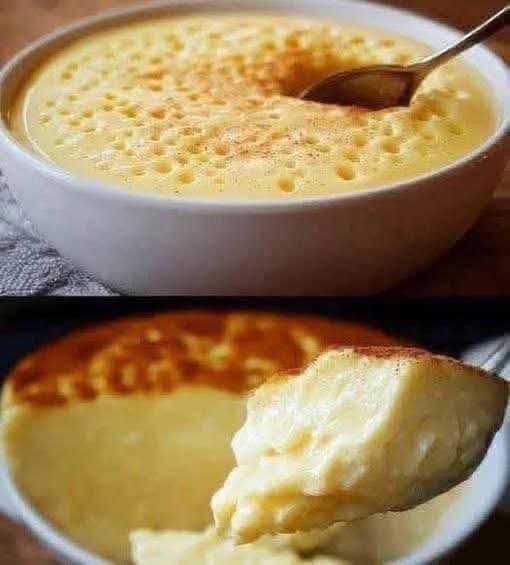
There is a profound comfort in a perfectly executed Classic Baked Egg Custard Pudding. This timeless dessert, celebrated across cuisines from France (crème renversée) to Spain (flan) and the Americas, relies on just four simple ingredients: eggs, milk, sugar, and vanilla. Unlike a stovetop pudding, this dessert is baked low and slow, often in a water bath, which allows the egg proteins to set gently into a smooth, quiveringly delicate structure. Served warm or chilled, and finished with a dusting of spice like cinnamon or nutmeg (as seen in the image), it is the ultimate expression of soothing, effortless elegance.
A Legacy of Simple Ingredients
Custard is one of the oldest forms of cooked desserts, dating back to Roman times. It is defined by its base of milk or cream thickened with egg yolks. The baked version, or crème brûlée (without the caramel) or simple crème anglaise set, became the standard because baking stabilizes the delicate egg structure, ensuring a smooth texture without the risk of over-thickening or scorching.
Our Classic Baked Egg Custard Pudding focuses on achieving three perfect qualities:
- Silky Smooth Texture: Achieved by straining the custard base and baking slowly in a water bath.
- Rich Flavor: Infusing the milk with vanilla bean or high-quality extract and finishing with spice.
- Clean Set: The key is knowing exactly when to remove the custard—when the edges are set but the center still jiggles lightly.
Essential Ingredients and Their Roles
Success hinges on the quality of the dairy and the careful handling of the eggs.
| Component | Essential Ingredient | Function | Substitution Notes |
| Structure | Large Eggs & Egg Yolks | Provide the essential thickening and setting agent. | Must be whisked gently to avoid excess air bubbles. |
| Base | Whole Milk or Half-and-Half | Provides the necessary liquid and fat for a creamy result. | Full-fat dairy is essential for richness; avoid skim milk. |
| Flavor | Granulated Sugar & Vanilla | Sweetens and flavors the base. | Can substitute the sugar with maple syrup or honey for a darker flavor. |
| Garnish | Cinnamon or Nutmeg | Adds aromatic warmth and visual appeal. | Essential for cutting the richness of the dairy. |
Nutritional Notes on Eggs and Dairy
This simple dessert provides substantial nutrition, especially when using full-fat dairy:
- Complete Protein: Eggs are one of the best sources of complete protein, containing all nine essential amino acids.
- Calcium and Vitamin D: Whole milk and cream are excellent sources of calcium and are often fortified with Vitamin D, important for bone health.
- Choline: Egg yolks are rich in choline, an important nutrient for brain health and metabolism.
Step-by-Step Instructions: Baking the Perfect Custard
The entire process focuses on gentle mixing and precise baking to ensure a smooth, set texture.
Stage 1: Preparing the Custard Base (15 minutes)
- Preheat and Prepare: Preheat the oven to $325^{\circ} \text{F}$ ($160^{\circ} \text{C}$). Bring a kettle of water to a boil.
- Infuse Milk: In a medium saucepan, combine 3 cups of whole milk (or half-and-half), 1/2 cup of granulated sugar, and 1 teaspoon of vanilla extract (or seeds from 1/2 a vanilla bean). Heat gently until the sugar is dissolved and the milk is steaming, but do not boil. Remove from heat.
- Mix Eggs: In a large bowl, gently whisk 4 large eggs and 2 large egg yolks until just combined and frothy. Do not over-whisk, as too much air creates bubbles that cause the finished custard to be full of holes (like the top surface shown in the image).
- Temper: Slowly pour the warm milk mixture into the eggs, whisking continuously. This tempering process gently heats the eggs without scrambling them.
Stage 2: Bake in the Water Bath (Bake time: 45–60 minutes)
- Strain: Pour the custard mixture through a fine-mesh sieve into a measuring cup or large liquid vessel. This removes any stray solids or air bubbles, guaranteeing a silky smooth texture.
- Prepare Bath: Place a 9-inch round baking dish or six individual ramekins in a large roasting pan. Pour the strained custard evenly into the dish(es).
- Water Bath: Place the roasting pan on the oven rack. Carefully pour the boiling water into the roasting pan so that it reaches halfway up the sides of the custard dish(es).
- Bake: Bake for 45 to 60 minutes. The custard is done when the edges are set and firm, but the center still has a slight, noticeable wobble when the pan is gently shaken.
Stage 3: Chill and Garnish (Chill time: Minimum 4 hours)
- Cool Slowly: Carefully remove the custard dish(es) from the water bath (leave the roasting pan in the oven to cool down). Allow the custard to cool completely on a wire rack for about 1 hour.
- Chill: Cover the dish(es) with plastic wrap and chill in the refrigerator for at least 4 hours, or preferably overnight. Chilling allows the custard to firm up completely into the set texture seen on the spoon in the image.
- Serve: Just before serving, dust the top generously with ground cinnamon or nutmeg. Serve chilled for a firmer texture or slightly warmed for a classic comfort experience.
Professional Tips for Silky Smooth Custard
- Gentle Whisking: The biggest enemy of smooth custard is air bubbles. Whisk the eggs only until they are just combined, and then use the straining step to remove any excess air.
- The Sieve is Essential: Don’t skip the straining step. It removes any chalazae (the stringy white bits of the egg) or tiny scrambled egg pieces that may have formed during tempering, ensuring a flawless texture.
- Check the Wobble: The perfect set is achieved when the edges are firm, but the interior still moves like very firm gelatin. Over-baking will result in a dry, crumbly, or spongy texture.
Common Mistakes to Avoid
- Boiling the Milk: If the milk is too hot, it will cook the eggs too quickly, leading to scrambled bits in your custard. Use steaming-hot milk, not boiling.
- Baking Too Hot: A high baking temperature will cook the exterior too fast, often causing the center to curdle or steam bubbles to form within the custard (the tiny holes visible in the top image). The water bath and $325^{\circ} \text{F}$ temperature are key.
- Serving Warm Immediately: While this custard can be served warm, it needs at least an hour to finish setting and firming up after it comes out of the oven.
Serving and Variation Ideas
- Caramelized Top: For a true crème brûlée (though the base is thinner), sprinkle the top of the chilled custard with a thin layer of granulated sugar and torch it until caramelized.
- Fruit Accent: Serve the chilled custard with a side of tart berries or a drizzle of raspberry coulis to complement the rich dairy.
- Spice Infusion: Add cardamom pods or a few strips of orange peel to the milk while it warms for a different aromatic complexity.
Storage and Leftovers
- Refrigeration: Store leftover Classic Baked Egg Custard Pudding covered in the refrigerator for up to 4 days.
- Freezing: Freezing is not recommended, as the delicate custard base will separate and weep upon thawing.
Frequently Asked Questions (FAQ)
Q: Why are there small holes/bubbles in the top of my custard?
A: These holes are caused by air being incorporated into the mixture (over-whisking the eggs) or the custard baking too quickly (oven too hot or no water bath). These pockets of steam try to escape, leaving holes.
Q: What is the benefit of using both whole eggs and extra yolks?
A: The extra yolks provide more fat, resulting in a much richer flavor and a silkier, more stable texture. The whole eggs provide some of the structure.
Q: Can I bake this without a water bath?
A: While possible, it is not recommended. The water bath provides insulation, keeping the edges from over-baking and the center from curdling, which is the secret to the silky, smooth texture.
Q: My custard is rubbery. What went wrong?
A: Rubberiness means the egg proteins were overheated and cooked too far past their setting point. This is usually caused by over-baking (leaving it in too long) or baking at too high a temperature.
A Timeless Treat
The Classic Baked Egg Custard Pudding is the perfect dessert for any occasion that calls for comforting, timeless elegance. Its simple beauty and velvety texture are a testament to the magic of minimal ingredients handled with care.
Enjoy the simple pleasure of this beautiful, traditional dessert today!