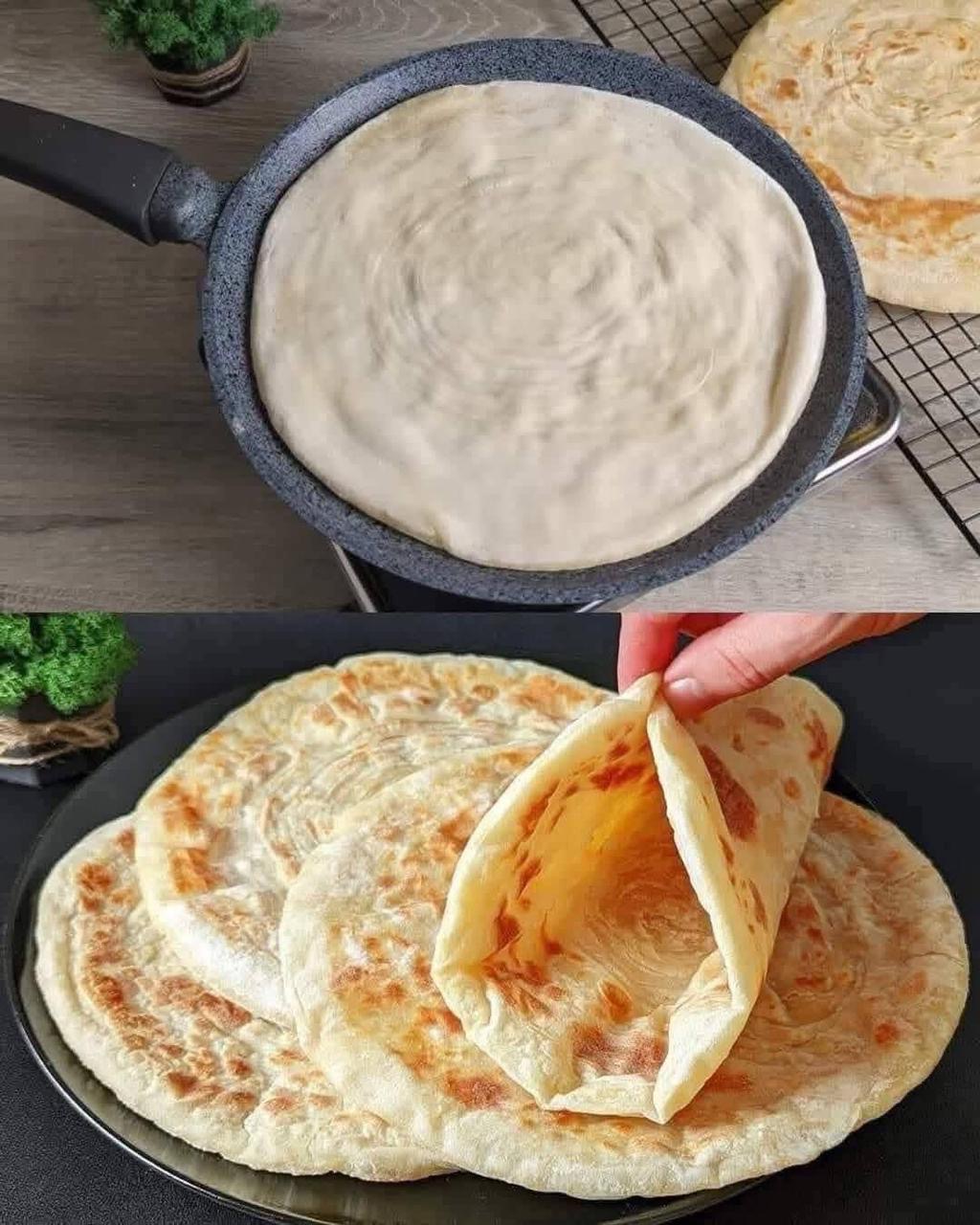
Homemade flatbread is one of the simplest yet most satisfying things you can make in your kitchen. The bread in your image is beautifully flexible, lightly blistered, and cooked to a golden finish in a dry skillet—ideal for sandwiches, wraps, dipping, or eating warm right off the pan. What makes this recipe special is its softness, stretchability, and the delicate layers that form naturally when the dough is properly rested and rolled.
This recipe requires only a few basic ingredients: flour, water, salt, a little oil, and time. But the magic lies in the kneading and resting process, which creates tender dough that cooks evenly and stays soft even after cooling.
🌾
INGREDIENTS (Makes 6–8 flatbreads)
Dry Ingredients
- 3 cups all-purpose flour
- 1 teaspoon salt
- 1 teaspoon sugar (optional, helps softness)
Wet Ingredients
- 1 cup warm water (add more if needed)
- 2 tablespoons vegetable oil OR melted butter
For brushing (optional but recommended)
- 2 tablespoons melted butter or olive oil
🧂 STEP 1 — Mix the Dry Ingredients
In a large mixing bowl, combine:
- Flour
- Salt
- Sugar
Mix these together so the salt distributes evenly. This helps prevent patches of tough dough.
💧 STEP 2 — Add Water and Oil
Make a well in the center of the dry mix and pour in:
- Warm water
- Oil or melted butter
Use a spoon or your fingers to gradually bring the flour into the liquid until a shaggy dough forms.
✋ STEP 3 — Knead Until Smooth
Transfer the dough to a lightly floured surface. Knead for 8–10 minutes by hand, or 5 minutes in a mixer with a dough hook.
You’re looking for:
- A soft dough
- Slight elasticity
- Smooth surface
If the dough feels dry, add 1 tablespoon of water at a time.
If it’s sticky, sprinkle a tiny bit of flour.
When done, the dough should be soft like your earlobe—not stiff, not sticky.
🛌 STEP 4 — Rest the Dough
Place the kneaded dough back in the bowl, cover with:
- Plastic wrap
OR - A damp towel
Let it rest for 30–40 minutes at room temperature.
This rest is crucial.
It relaxes the gluten, making the dough easier to roll out thin and allowing the bread to puff and form natural layers while cooking.
🟢 STEP 5 — Divide and Shape
After resting, divide the dough into:
- 6 pieces (for large flatbreads)
- 8 pieces (for smaller ones)
Roll each piece into a smooth ball. Cover again for 10 more minutes.
This second rest makes rolling much easier and gives ultra-soft results.
🧂 STEP 6 — Optional Layering Technique (For Extra Softness)
To mimic the slightly layered look in your image:
- Roll one dough ball into a thin circle.
- Brush the surface lightly with oil or melted butter.
- Roll the dough like a jelly roll.
- Coil it into a spiral shape (like a snail).
- Rest for 5 minutes before flattening it again.
This creates natural flakes and softness.
🍳 STEP 7 — Roll Out the Flatbreads
On a floured surface, roll each ball into a thin circle about 2–3 mm thick.
Try to keep them even so they cook uniformly.
You shouldn’t need much flour—too much makes the bread dry.
🔥 STEP 8 — Cook on a Skillet
Heat a pan over medium or medium-high heat. No oil is needed.
Place one rolled flatbread onto the hot pan.
Cook for:
- 45–60 seconds until bubbles form
- Flip and cook another 45–60 seconds
The bread should develop:
- Golden brown spots
- Soft flexible texture
- Slight puffing
If the bread blackens too quickly → heat is too high.
If it stays pale and dries out → heat is too low.
Press lightly with a spatula to help it puff.
Repeat for the rest of the dough.
🧈 STEP 9 — Brush and Cover
As soon as each flatbread comes off the pan:
- Brush lightly with butter or oil (optional but delicious)
- Stack them
- Cover with a clean towel
This helps keep them soft and warm, preventing drying.
🍽️ HOW TO SERVE
These soft skillet flatbreads are incredibly versatile. You can use them for:
Savory Uses
- Wraps and sandwiches
- Shawarma, gyro, kebab
- Tacos, quesadillas
- Falafel wraps
- Dipping in hummus or garlic sauce
Sweet Uses
- Spread with Nutella
- Drizzled with honey
- Cinnamon-sugar bread
Breakfast Ideas
- Rolled with scrambled eggs
- Filled with cheese and toasted
- Used as a base for pizza
Because of their softness, they fold beautifully without tearing.
💡 PRO TIPS FOR PERFECT FLATBREAD
1. Resting is crucial
More rest = softer bread. Do not skip resting the dough before rolling.
2. Don’t over-flour
Too much flour creates dry, tough breads.
3. Cook on medium-high
High enough for browning, low enough for tenderness.
4. Stack & cover
Stacking creates steam that keeps the bread flexible.
5. Use warm water only
Cold water makes dough stiff.
⭐ WHY THIS RECIPE WORKS SO WELL
This recipe creates:
- Soft, fluffy texture
- Bendy, flexible bread—just like in your photo
- Beautiful golden spots
- Slight layers inside thanks to resting + optional oil spiral
- Long-lasting softness, even after cooling
It’s beginner-friendly yet produces professional-level results.
The beauty of this recipe is its simplicity—flour, water, salt—and how these humble ingredients transform into something so versatile and comforting.